

Don't Waste Your Injury
What Your Running
Injury Is Trying to
Teach You
For years, I had a sticky note hanging in the University of Utah Runner's Clinic that read:
Don't waste your injury.
I don't remember where I first heard the phrase or what prompted me to write it down, but I put it on the wall and left it there until the sun faded the writing and I could no longer read it.
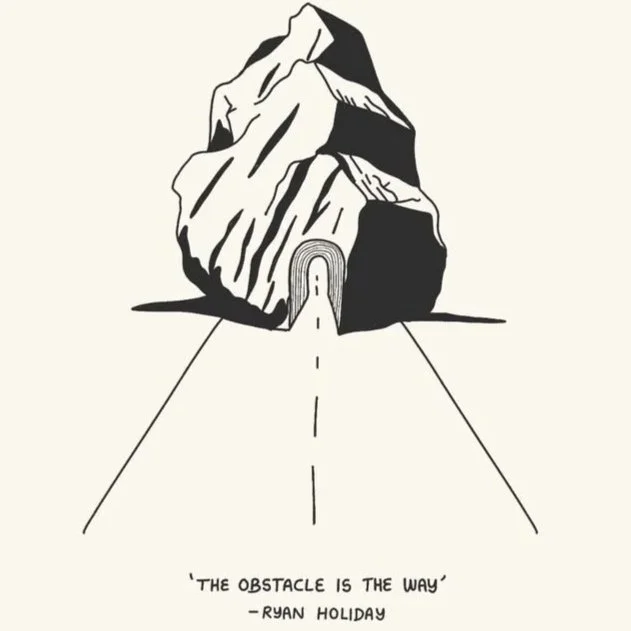
I recently finished The Obstacle Is the Way by Ryan Holiday. The book is built around the idea that the obstacles in front of us are not necessarily blocking the path forward. Sometimes, the obstacle itself becomes the path.
As I was reading, I kept thinking about that old sticky note.
Don't waste your injury.
As runners, we naturally see injuries as problems. Interruptions. Ticking time bombs. They derail our training, disrupt our plans, and keep us from moving toward our goals.
But what if we looked at them differently?
Think about a barking dog. The barking can certainly be annoying. Sometimes the dog is simply barking. But barking is also one of the only ways a dog can communicate. The question isn't simply:
"How do I make the barking stop?"
The better question is:
"Why is the dog barking?"
I was recently working with a runner—let's call him Tim—who had been dealing with repeated calf strains during interval workouts. His calf was the obvious problem (and it was most certainly barking at him).
But once we started looking into his running form, it became clearer why his calf was getting aggravated.
As Tim ran faster, his primary strategy for creating speed was to make his stride longer. He reached farther in front of him and pushed harder behind him. His cadence didn't increase enough to match the demands of faster running, so his posterior chain—particularly his calves—kept paying the price.
The calf strain was his obstacle, but it also exposed something that years of successful running had hidden.
Tim had a limited strategy for running fast.
The answer wasn't simply to rest until his calf stopped hurting and then return to the same plan. We needed to expand his options.
So, we worked on changing how he created speed by driving his knees forward, increasing his turnover, and striking more vertically into the ground instead of relying so heavily on a long stride and a hard push behind him. Strength testing also revealed very weak hip flexors, giving us another very important piece of the puzzle.
Now, he's back to interval training and doing well, yet the most interesting part of his story isn't that his calf feels better.
It's that the injury forced an investigation that taught him something about his running, something that he may never have even discovered otherwise.
To me, this is what it means to not waste an injury.
If Tim's only goal had been to get back to his original training plan, he may have rested until his calf felt better and then returned to the exact same speed work with the exact same running strategy.
The obstacle would have been temporarily removed, but nothing would have changed.
The plan itself would have led him back to the same problem.
Instead, the injury changed the route. A route that gave us the opportunity to dig deeper and refuse to walk away empty-handed.
Sometimes an injury tells us our training progressed faster than our tissues were ready for.
Sometimes it reveals that we've built a powerful engine without a strong enough chassis underneath it.
Sometimes it exposes an old injury that's still influencing how we move.
Sometimes it uncovers weaknesses, mobility limitations, recovery habits, or life stress that have quietly been accumulating beneath the surface.
The symptom may be the thing that stops us, but it may also be the thing that finally shows us where we need to look. This doesn't mean every injury happens for a reason. It doesn't mean we should be thankful to be injured, and it certainly doesn't mean every setback contains some profound life lesson.
Instead, once the injury is in front of us, we get to take the reins and decide what we do with it.
Do we spend all our energy trying to get back to where we once were? Or do we become curious?
Why is the dog barking? What is this injury trying to tell me? What needs more strength? More capacity? A different movement strategy? Better recovery? A more flexible approach to training?
The goal doesn't always have to be getting back to exactly who we were before the injury.
Maybe the better goal is to become a runner who is stronger, more resilient, and more adaptable because of what the injury taught us.
The injury may not be the path we wanted.
But sometimes, it becomes the path we need.
Don't waste your injury.